Reports
Press coverage and detailed reports on unfolding events
2026-09-19
.
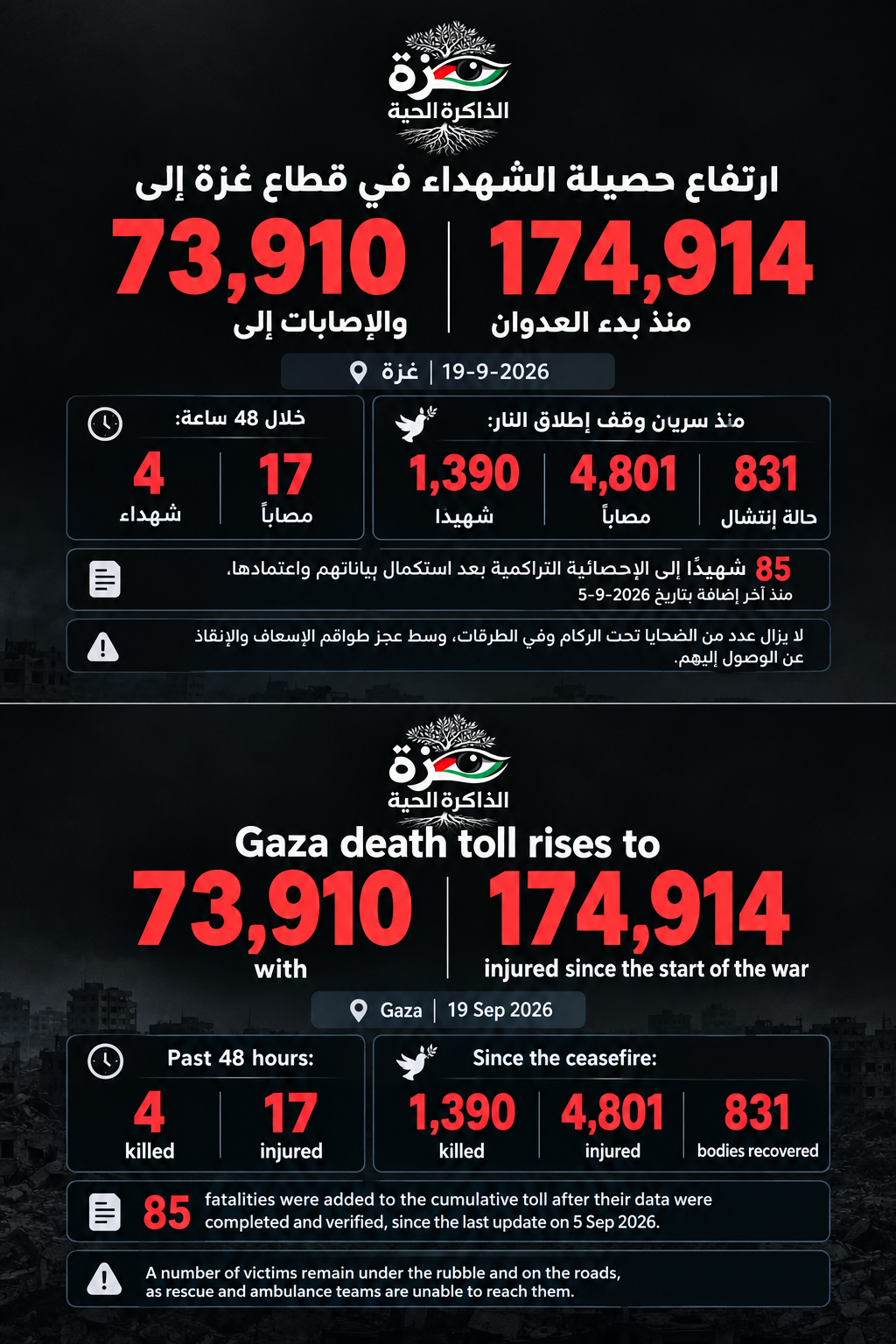
The death toll in the Gaza Strip has risen to 73,910, and injuries to 174,914 since the start of the aggression.
Gaza, Sept 19, 2026 – The death toll from the war of genocide waged by the Israeli occupation forces on the Gaza Strip has risen to 73,910 martyrs and 174,914 injured since October 7, 2023.
Medical sources stated today, Saturday, that hospitals in the Strip received 4 martyrs and 17 injured during the past 48 hours.
The sources added that the total number of martyrs since the ceasefire went into effect on October 11 last year has risen to 1,390 martyrs, and the injured to 4,801, while the total number of recovered bodies reached 831.
It was noted that 85 martyrs were added to the cumulative death toll after completing and approving their data, since the last update to the statistics on September 5, 2026.
Medical sources indicated that a number of victims remain under the rubble and on the roads, as ambulance and rescue crews are still unable to reach them.
2026-09-17
.
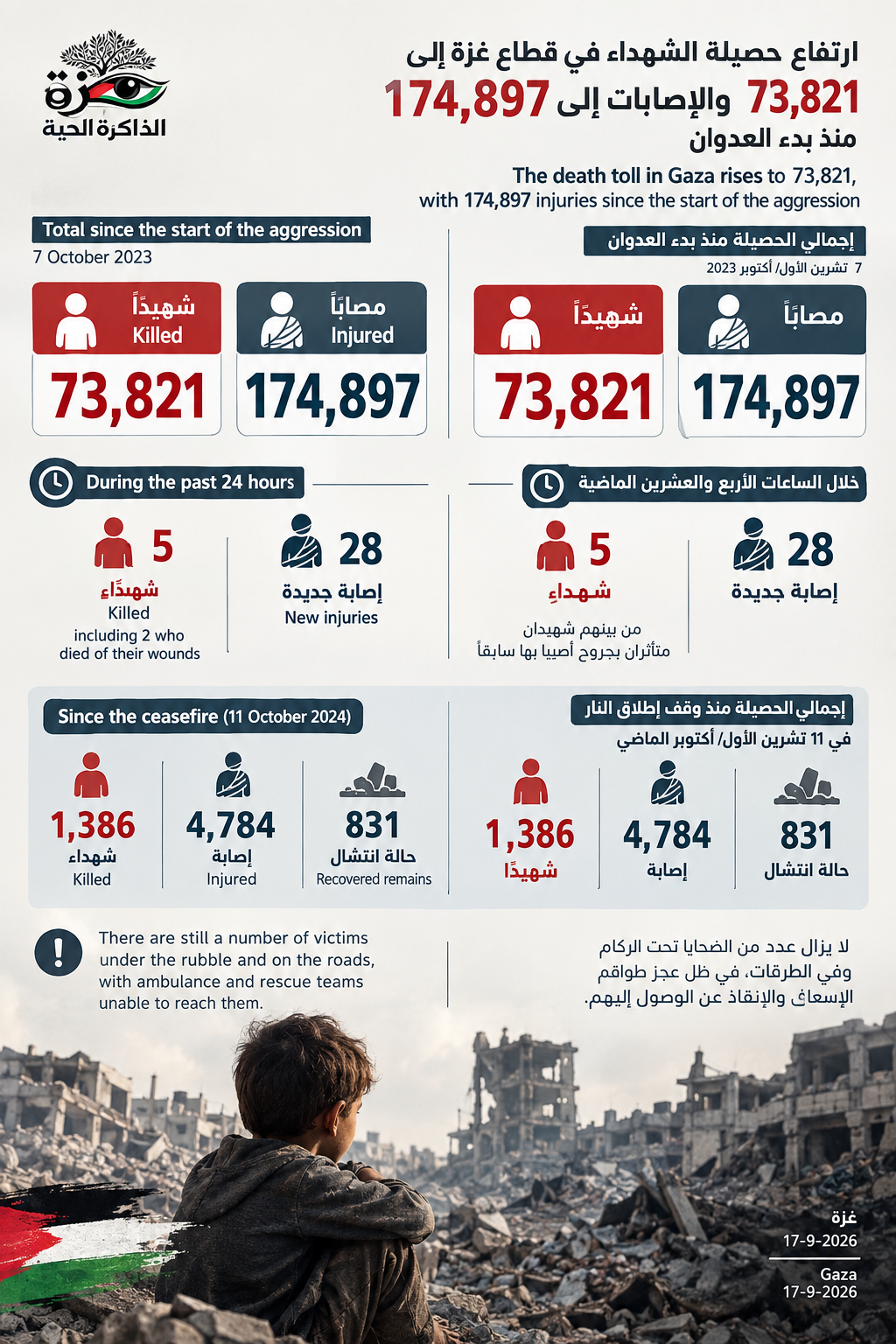
Death Toll in Gaza Strip Rises to 73,821, Injuries to 174,897 Since Beginning of Aggression
GAZA, September 17, 2026 — The death toll from the war of genocide waged by Israeli occupation forces on the Gaza Strip has risen to 73,821 martyrs and 174,897 injured since October 7, 2023.
Medical sources reported that over the past 24 hours, hospitals in the Gaza Strip received 5 martyrs, including two who succumbed to previous wounds, in addition to 28 new injuries.
The sources indicated that the total number of martyrs since the ceasefire took effect on October 11 last year has risen to 1,386, and injuries to 4,784, while the total number of recovered bodies reached 831. They noted that a number of victims remain under the rubble and on the streets, as ambulance and rescue crews are unable to reach them.
2026-09-17
.
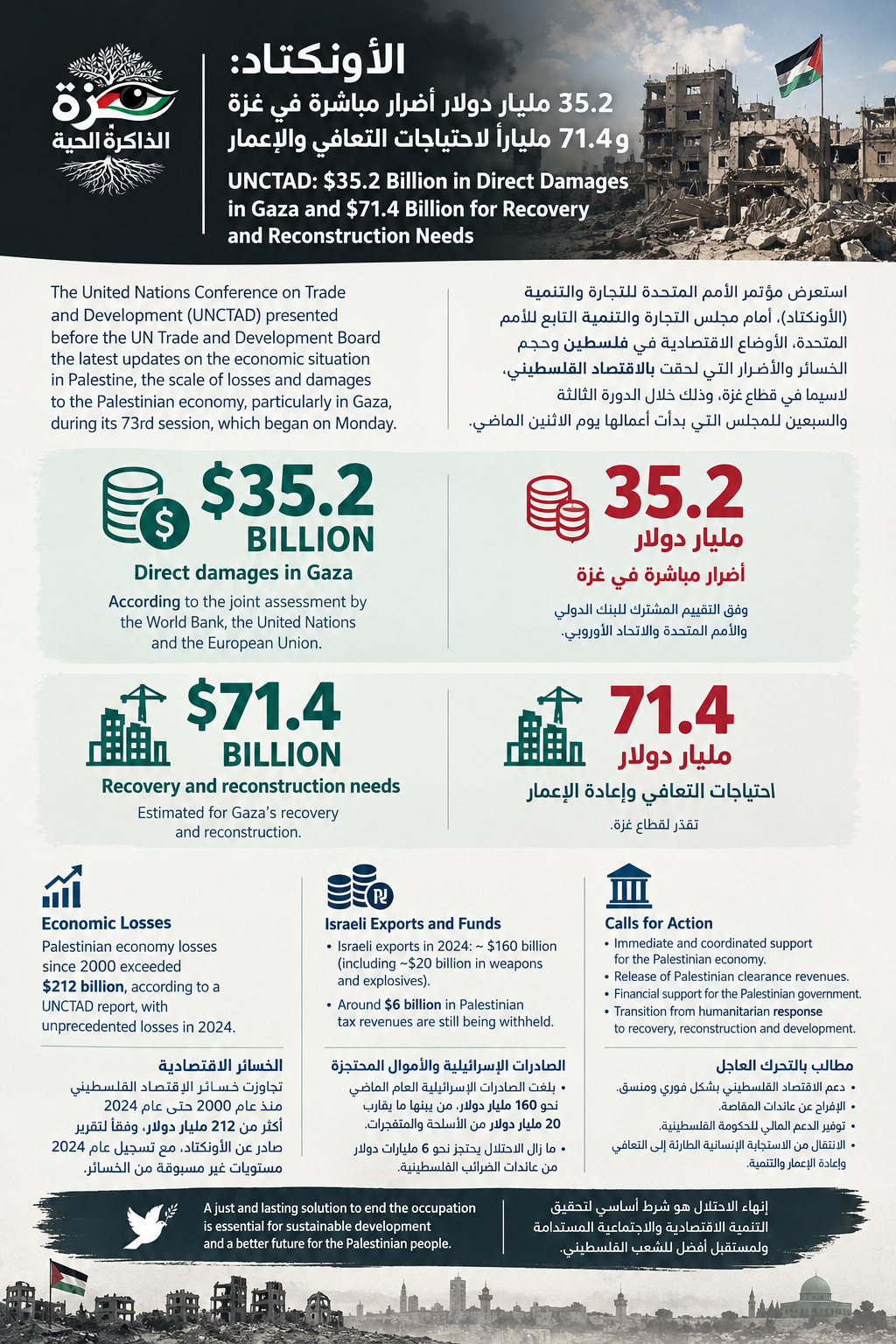
UNCTAD: $35.2 Billion in Direct Damages in Gaza and $71.4 Billion for Recovery and Reconstruction Needs
The United Nations Conference on Trade and Development (UNCTAD) presented a review of the economic conditions in Palestine and the scale of losses and damages inflicted on the Palestinian economy, particularly in the Gaza Strip, before the UN Trade and Development Board during its 73rd session, which commenced last Monday.
The Acting Secretary-General of UNCTAD, Pedro Manuel Moreno, reviewed the extent of the damage caused to the infrastructure, productive sectors, and basic services in the Gaza Strip. He noted that direct material damages reached approximately $35.2 billion, according to a joint assessment by the World Bank, the United Nations, and the European Union, while recovery and reconstruction needs are estimated at around $71.4 billion.
Mutasim Elagraa, Coordinator of the Assistance to the Palestinian People Unit at UNCTAD, provided an explanation regarding the deterioration of economic conditions in Palestine, especially in the Gaza Strip, resulting from the aggression, destruction, and blockade, alongside the economic and financial restrictions imposed on the West Bank.
In a recorded speech delivered to the meeting, Prime Minister Mohammad Mustafa emphasized that achieving economic recovery and development requires ending the occupation, enabling the Palestinian people to exercise sovereignty over their resources and borders, and lifting restrictions on the movement of people, goods, and investment. He called for a revision of the Paris Economic Protocol to prevent the perpetuation of economic dependency.
Ambassador Ibrahim Khraishi, the Coordinator of the Arab Group and Permanent Observer of the State of Palestine in Geneva, delivered the statement of the Arab Group, affirming its support for UNCTAD's efforts to assist the Palestinian people and strengthen their developmental capacities.
The Arab Group called on UNCTAD to continue assessing the economic cost of the occupation, preparing studies related to trade and development in Palestine, and updating estimates of damages and losses in line with its mandate and UN resolutions. It also urged the international community and donors to provide the necessary resources to support the organization's work and build Palestinian institutions, stressing that ending the occupation is a fundamental prerequisite for achieving sustainable economic and social development.
The session featured interventions from the Group of 77 and China, the European Union, the African Group, the Asia-Pacific Group, the Group of Friends in Defense of the Charter of the United Nations, and the Group of Least Developed Countries, alongside a number of countries and regional and international organizations.
Participants called for urgent and coordinated action to support the Palestinian economy, release clearance revenue (tax revenues), provide financial support to the Palestinian government, and transition from an emergency humanitarian response to recovery, reconstruction, and development.
The interventions emphasized that colonial expansion, the fragmentation of Palestinian land, and restrictions imposed on movement, trade, and investment undermine the prospects for development and the establishment of a viable Palestinian state. They stressed that reviving the Palestinian economy requires, in addition to aid and reconstruction, addressing the structural causes of the crisis and reaching a just and lasting political solution that ends the occupation and paves the way for sustainable Palestinian development.
At the conclusion of the session, the Permanent Representative of the State of Palestine to the United Nations in Geneva spoke in his national capacity, thanking the groups and countries that delivered statements and noting what had been heard from the Prime Minister and relevant authorities regarding the current conditions and challenges facing the Palestinian people.
He explained that the losses of the Palestinian economy from 2000 to 2024 exceeded $212 billion, according to a report issued by UNCTAD, pointing out that the year 2024 witnessed unprecedented levels of losses.
He added that the volume of Israeli exports during the past year reached approximately $160 billion, including nearly $20 billion in weapons and explosives, noting that these weapons were used, according to his statement, against the Palestinian people. He also pointed to the continuous withholding of about $6 billion in Palestinian tax revenues.
The Ambassador expressed his hope that the United Nations General Assembly, during its upcoming meeting and in coordination with the countries that supported the New York Declaration and those participating in the International Coalition for the Implementation of the Two-State Solution, would take practical steps and measures to help end the tragedy experienced by the Palestinian people.
He referred to the report of the organization "B'Tselem," which concluded, as he mentioned, that what is happening in the Gaza Strip is genocide, and what is occurring in the West Bank is an apartheid system and ethnic cleansing, calling on the international community to take concrete measures toward the occupying power in light of these reports and practices.
He welcomed new international stances, including the statement issued by 12 countries last Tuesday, expressing hope that these statements and positions would be translated into practical steps to stop the violations, violence, and terrorism to which the Palestinian people are subjected.
Concluding his speech, the Permanent Representative expressed hope for reaching a comprehensive resolution by consensus addressing all agenda items of the current session, wishing that future meetings would be held under better circumstances, and that the Palestinian people and the international community would witness positive developments contributing to the achievement of security, peace, and stability.
2026-09-16
.
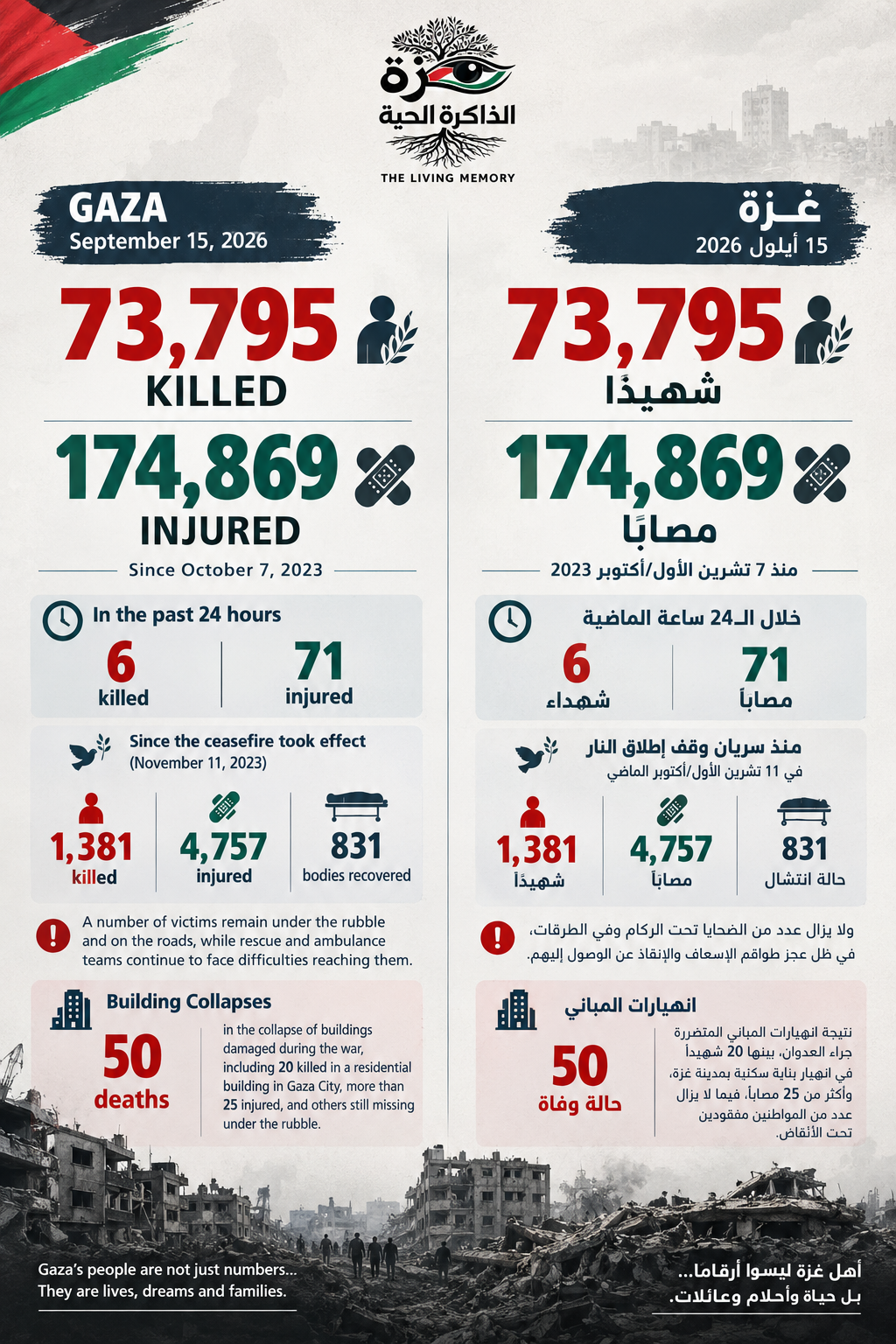
"The number of martyrs in the Gaza Strip has increased to 73,795, and injuries to 174,869."
Gaza, Sept 15, 2026 – The death toll from the war of genocide waged by Israeli occupation forces on the Gaza Strip has risen to 73,795 martyrs and 174,869 injured since October 7, 2023.
Medical sources reported that hospitals in the Gaza Strip received 6 martyrs and 71 injured individuals over the past 24 hours.
The sources added that the total number of martyrs since the ceasefire took effect on October 11 has risen to 1,381, with injuries reaching 4,757, while the total number of recovered bodies stands at 831.
They noted that a number of victims remain under the rubble and on the streets, as ambulance and rescue crews are unable to reach them.
The sources also highlighted that the death toll from the residential building collapse in Gaza City has risen to 20 martyrs, with over 25 others injured, while several citizens remain missing under the debris. This brings the total number of casualties from building collapses damaged by the aggression to 50 fatalities.
2026-09-15
.
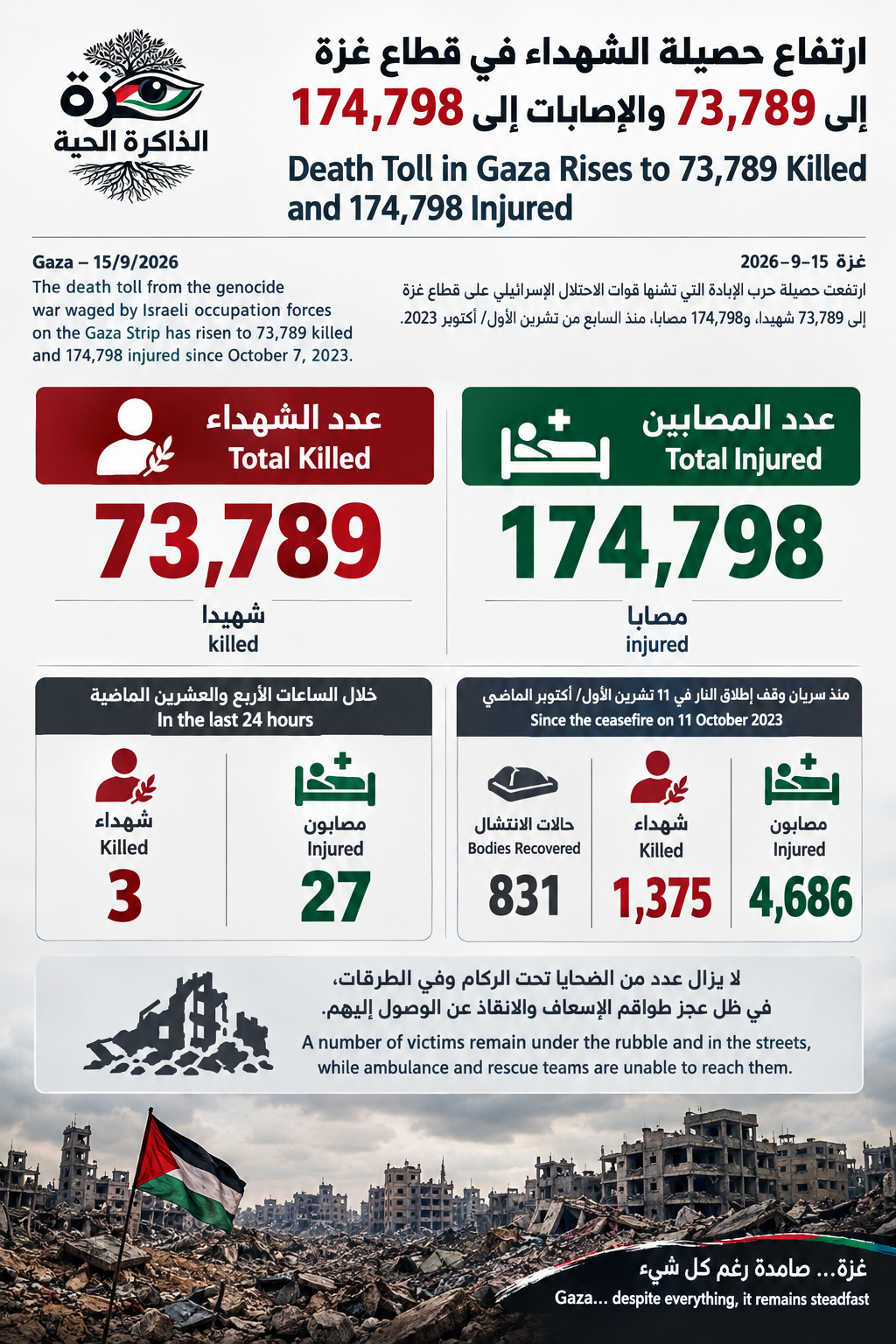
"The death toll in the Gaza Strip has risen to 73,789, with injuries reaching 174,798.
"Gaza, Sept 15, 2026 – The death toll from the war of genocide waged by the Israeli occupation forces on the Gaza Strip has risen to 73,789 martyrs and 174,798 injured since October 7, 2023.
Medical sources reported that hospitals in the Strip received 3 martyrs and 27 injured individuals over the past 24 hours.
The sources clarified that the total number of martyrs since the ceasefire took effect on October 11 has risen to 1,375, with injuries reaching 4,686, while the total number of recovered bodies stands at 831.
They further noted that a number of victims remain under the rubble and on the streets, as ambulance and rescue crews are unable to reach them."
2026-09-14
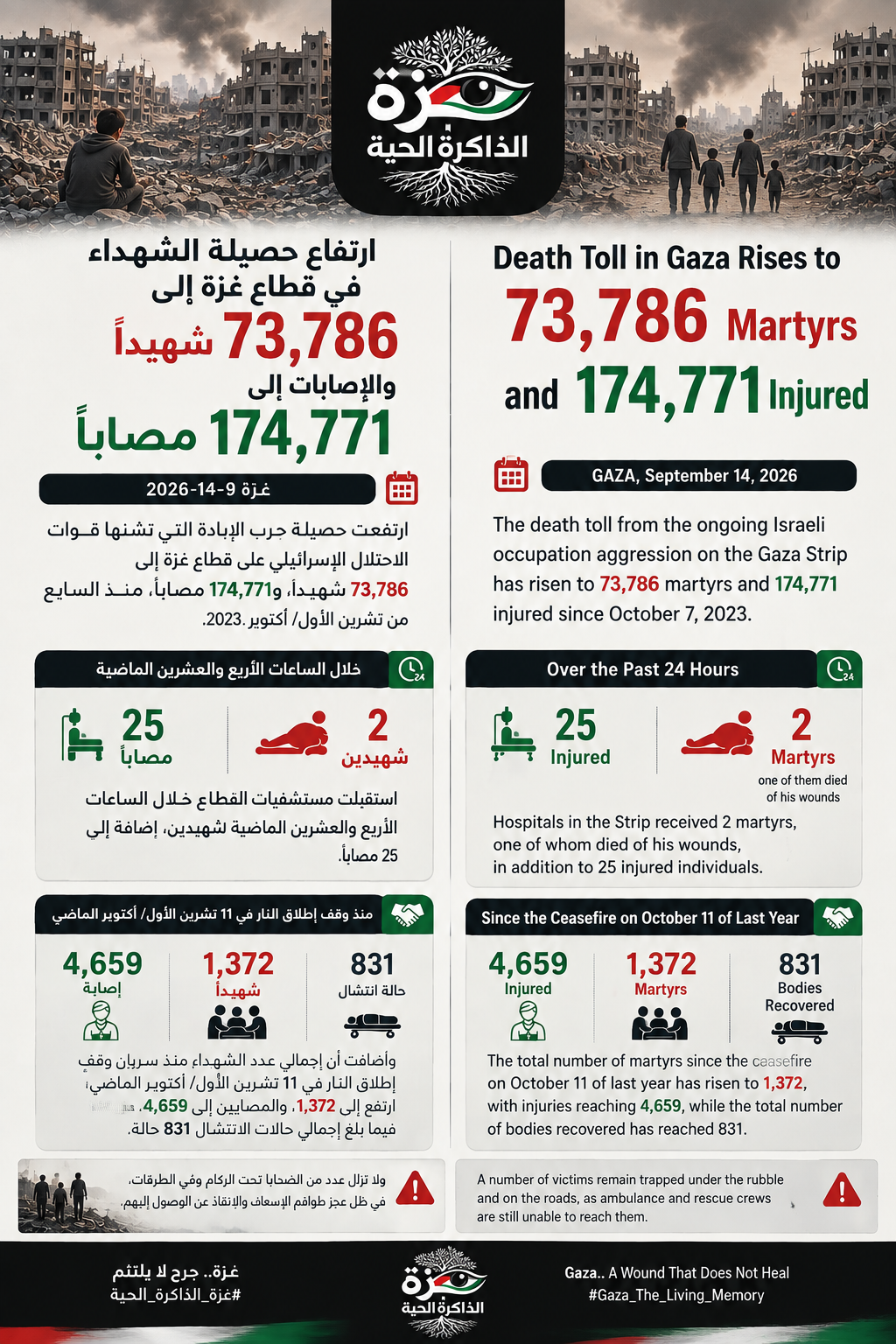
The death toll from the Israeli war on the Gaza Strip has risen to 73,786, with injuries reaching 174,771 since October 7, 2023.
Medical sources reported that hospitals in the Strip received two martyrs and 25 injured individuals over the past 24 hours.
The sources added that the total number of martyrs since the ceasefire took effect on October 11 has risen to 1,372, and the injured to 4,659, while the total number of recovered bodies reached 831.
They clarified that a number of victims remain under the rubble and on the streets, as ambulance and rescue crews are still unable to reach them.
.
2026-09-14
.
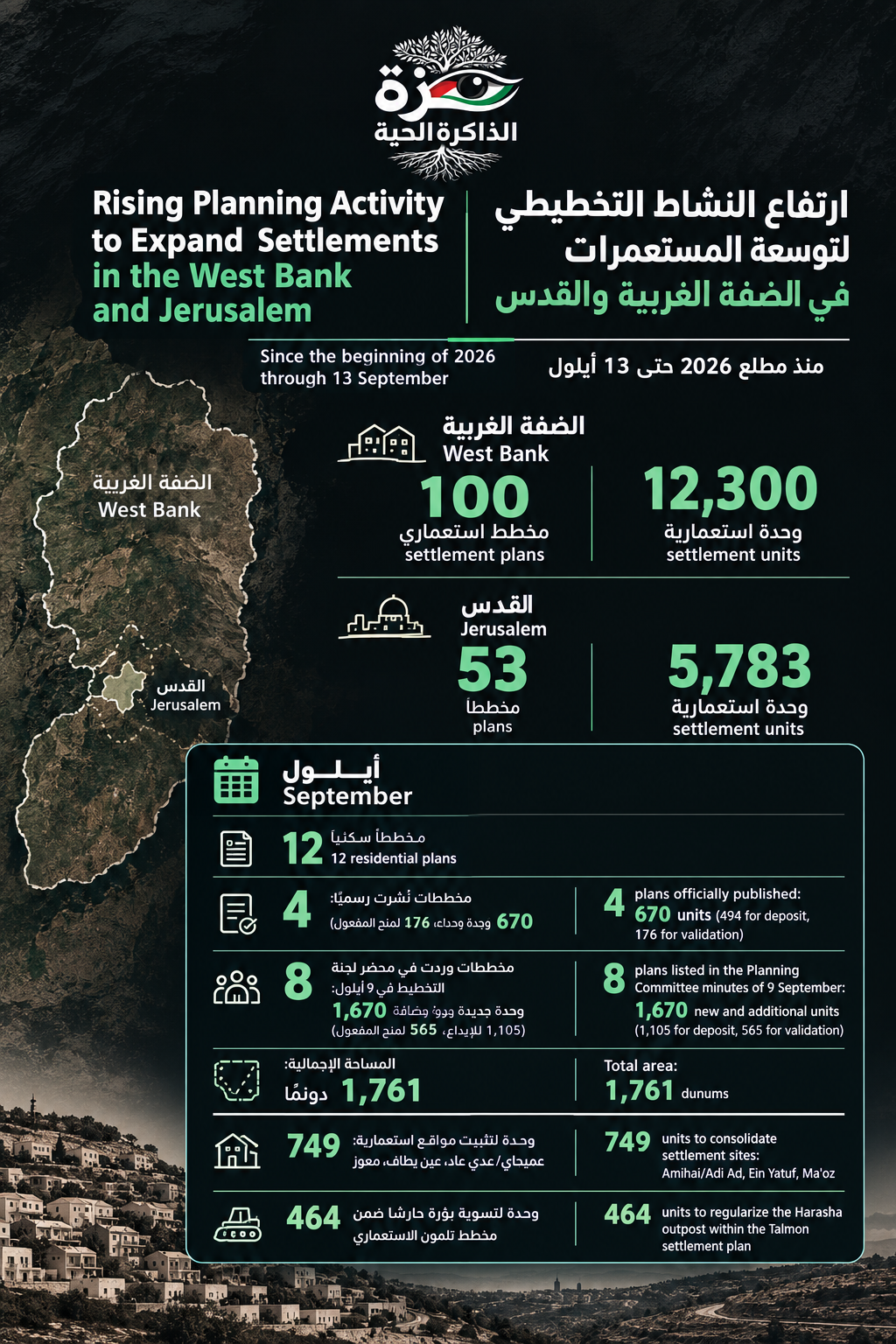
"The Wall and Settlement Resistance Commission": Increased planning activity to expand settlements in the West Bank, including Jerusalem.
Ramallah – Data compiled by the Wall and Settlement Resistance Commission indicates a surge in planning activities dedicated to expanding settlements. Since the beginning of 2026 until September 13, the cumulative total in the West Bank reached 100 examined settlement plans, encompassing 12,300 settlement units. In addition, 53 plans aimed at constructing 5,783 units in Jerusalem within the borders of the occupation municipality.
The Commission added in a statement on Sunday that the month of September witnessed the advancement of 12 residential plans. Among these, 4 plans were officially published and comprise 670 units (494 for depositing and 176 for validation). The remaining 8 plans were included in the minutes of the planning committee meeting held on September 9, adding 1,670 new and expanded units (1,105 for depositing and 565 for validation) spanning a total area of 1,761 dunams.
It further noted that during September, 749 units were designated for review to legalize and establish settlement sites such as "Amihai/Adei Ad", "Ein Yitav", and "Ma'oz". This is in addition to 464 units aimed at regularizing the "Harasha" outpost as part of the "Talmon" settlement plan.
2026-09-14
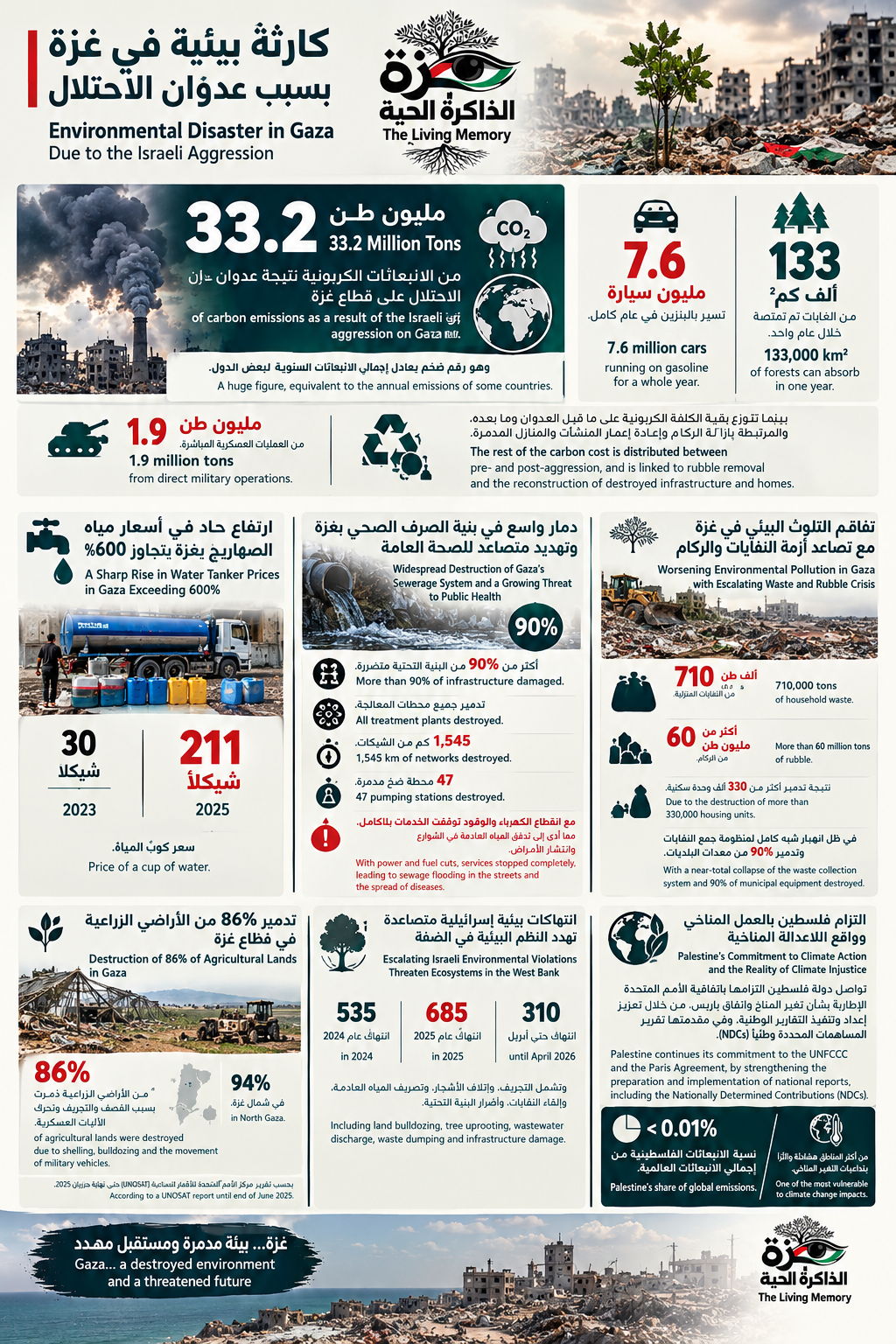
"An environmental disaster in Gaza due to the occupation's aggression: 33.2 million tons of carbon emissions."
"Ramallah - Carbon emissions resulting from the Israeli occupation's aggression on the Gaza Strip reached 33.2 million tons of CO2 equivalent—a massive figure equal to the total annual emissions of some entire countries.
The Palestinian Central Bureau of Statistics (PCBS) explained that these emissions are equivalent to what about 7.6 million gasoline-powered cars produce in a whole year, and what forests spanning an area of 133,000 square kilometers can absorb of carbon dioxide within a single year.
The PCBS pointed out that this catastrophic cost is distributed between direct military operations, which caused the emission of about 1.9 million tons, and the pre- and post-aggression carbon costs linked to debris removal and the reconstruction of destroyed facilities and homes.
Sharp Rise in Water Tanker Prices in Gaza Exceeds 600%
The destruction of water networks in the Gaza Strip led to a sharp rise in water prices, particularly those distributed by tankers, as the price of a cubic meter of water rose to about 211 shekels in 2025 compared to 30 shekels in 2023, reflecting the worsening water crisis and the economic burden on citizens.
Widespread Destruction in Gaza's Wastewater Infrastructure and a Rising Threat to Public Health
The Gaza Strip is also witnessing an almost complete collapse of the sanitation system as a result of damage to more than 90% of the infrastructure and the destruction of all treatment plants, in addition to widespread destruction of networks (about 1,545 km) and 47 pumping stations. With the continuous power and fuel outages, services have stopped completely, leading to the flow of wastewater into the streets, rising environmental and health risks, and the spread of diseases.
Worsening Environmental Pollution in Gaza with the Escalation of the Waste and Debris Crisis
The Gaza Strip suffers from severe environmental degradation due to the accumulation of about 710,000 tons of domestic waste and more than 60 million tons of rubble resulting from the destruction of over 330,000 housing units. This comes amid an almost complete collapse of the waste collection system and the destruction of 90% of municipal equipment, which has led to the spread of pollution and diseases, worsening the environmental crisis and complicating recovery efforts.
Destruction of 86% of Agricultural Land in the Gaza Strip
A recent report by the United Nations Satellite Centre (UNOSAT) up to the end of June 2025 showed that the Israeli aggression caused widespread destruction to the agricultural sector in Gaza, as about 86% of agricultural land was destroyed due to bombardment, bulldozing, and the movement of military vehicles. Higher levels of destruction were recorded in some areas, with the destruction rate rising to 94% in northern Gaza. This rapid and continuous collapse of the agricultural sector reflects a direct and serious threat to the food security of more than two million people in the Strip.
Escalating Israeli Environmental Violations Threaten Ecosystems in the West Bank
The year 2025 witnessed a noticeable escalation in Israeli environmental violations in the West Bank, where 685 violations were recorded compared to 535 violations in 2024, and 310 violations were recorded until the end of April 2026. This reflects escalating attacks on the Palestinian environment. These violations varied between bulldozing agricultural land, destroying trees, discharging wastewater, and dumping waste, in addition to infrastructure damage, leading to increasing degradation of ecosystems and threatening the sustainability of natural resources.
The State of Palestine continues its commitment to the United Nations Framework Convention on Climate Change (UNFCCC) and the Paris Agreement by strengthening the preparation and implementation of national reports—foremost among them the Nationally Determined Contributions (NDCs) report—as a key tool for guiding climate action, enhancing adaptation, supporting national policies, and attracting green investments.
Despite the worsening environmental and climate challenges, Palestine's contribution to global greenhouse gas emissions remains extremely limited, with national Palestinian emissions estimated at less than 0.01% of total global emissions—a negligible percentage compared to major industrial countries. Nevertheless, Palestine is considered one of the most vulnerable regions affected by the repercussions of climate change. This reality reflects a state of 'climate injustice,' where Palestine bears the impacts of a global climate crisis despite its very minor contribution to causing it."
.
2026-09-12
.
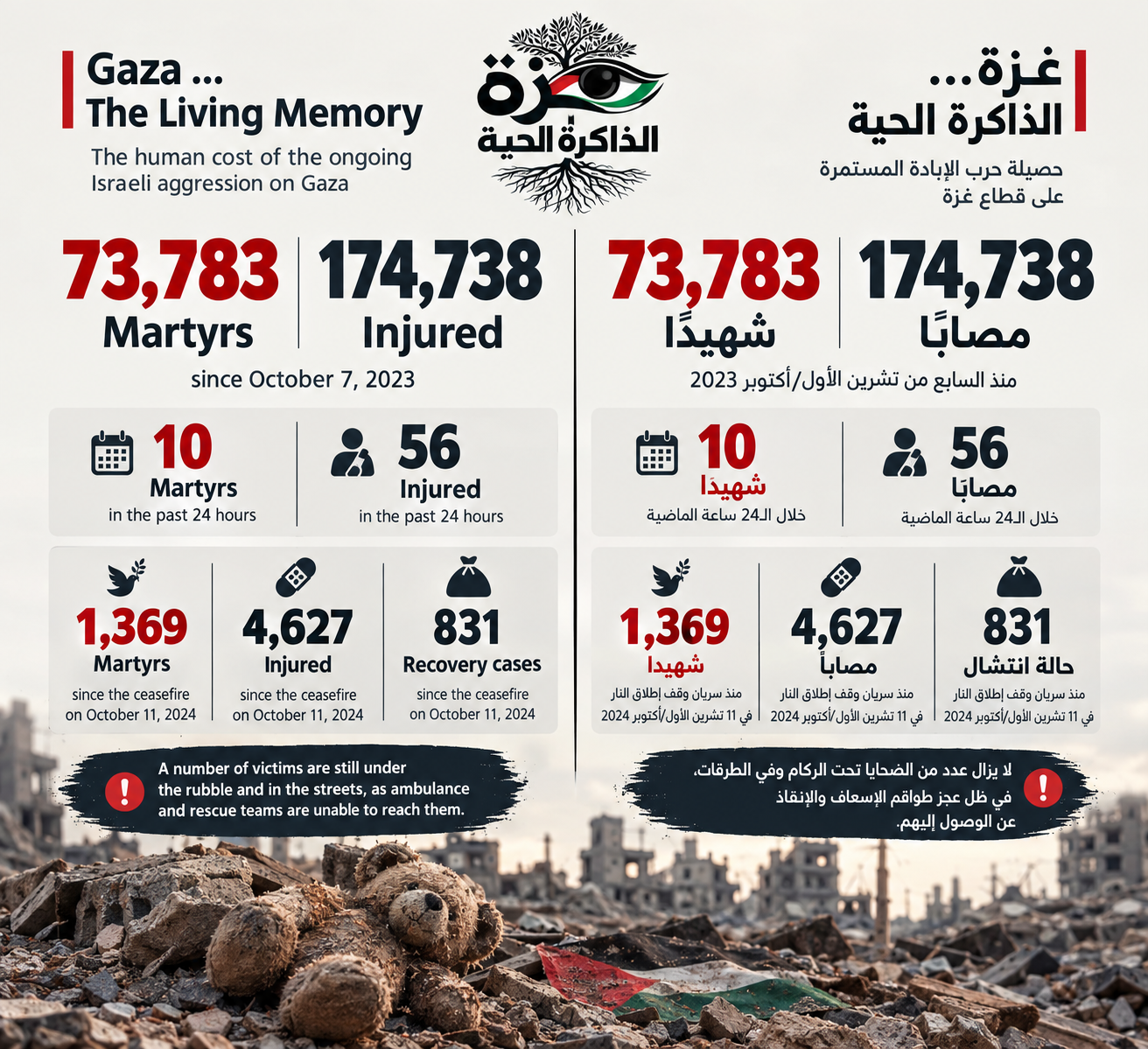
The death toll in the Gaza Strip has risen to 73,783, and injuries have reached 174,738.
Gaza, September 12, 2026 – The death toll from the war of genocide waged by the Israeli occupation forces on the Gaza Strip has risen to 73,783 martyrs and 174,738 injured since October 7, 2023.
Medical sources reported that hospitals in the Strip received 10 martyrs and 56 injured over the past 24 hours.
The sources added that the total number of martyrs since the ceasefire took effect on October 11 last year has risen to 1,369, and injuries to 4,627, while the total number of recovered bodies reached 831.
They explained that a number of victims remain under the rubble and on the roads, as ambulance and rescue crews are still unable to reach them.
2026-09-09
.
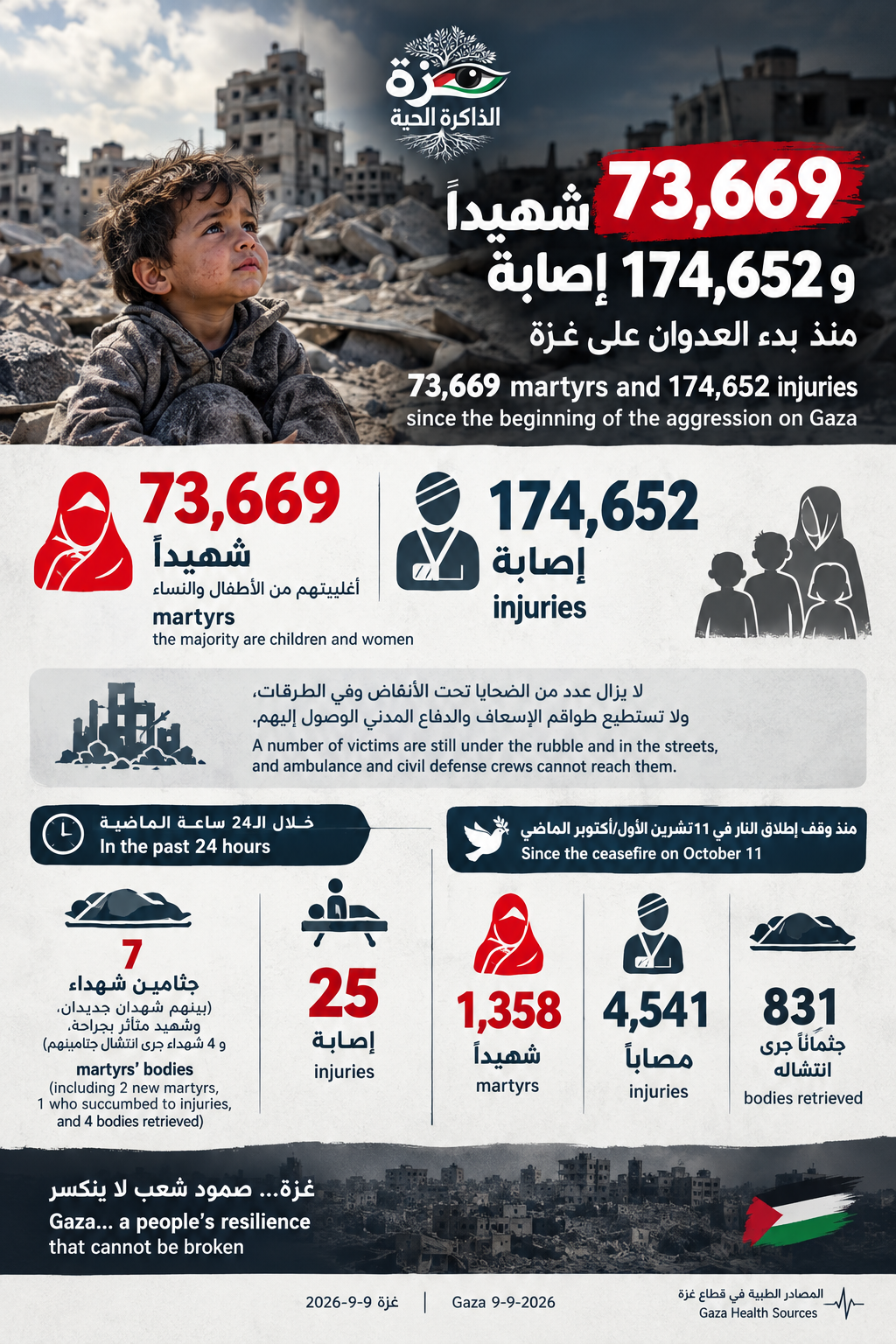
"73,669 martyrs and 174,652 injuries since the beginning of the aggression on Gaza."
"Gaza, 9-9-2026 - Medical sources announced today, Wednesday, that the death toll in the Gaza Strip has risen to 73,669 martyrs, the majority of whom are women and children, since the beginning of the Israeli occupation's aggression on October 7, 2023.
The sources added that the number of injuries has risen to 174,652 since the beginning of the aggression, while a number of victims remain under the rubble and on the streets, with ambulance and civil defense crews unable to reach them.
They explained that over the past 24 hours, the bodies of 7 martyrs arrived at hospitals in the Gaza Strip—including two newly martyred, one who succumbed to his wounds, and 4 whose bodies were recovered—in addition to 25 injuries.
In a related context, the toll of martyrs and injuries since the ceasefire on October 11 last year reached 1,358 martyrs and 4,541 injuries, while 831 bodies have been recovered."