From October 7, 2023 to Mid-2026: Israeli Settlement Expansion in the West Bank in Numbers – The Largest Land Appropriation Campaign Since 1967
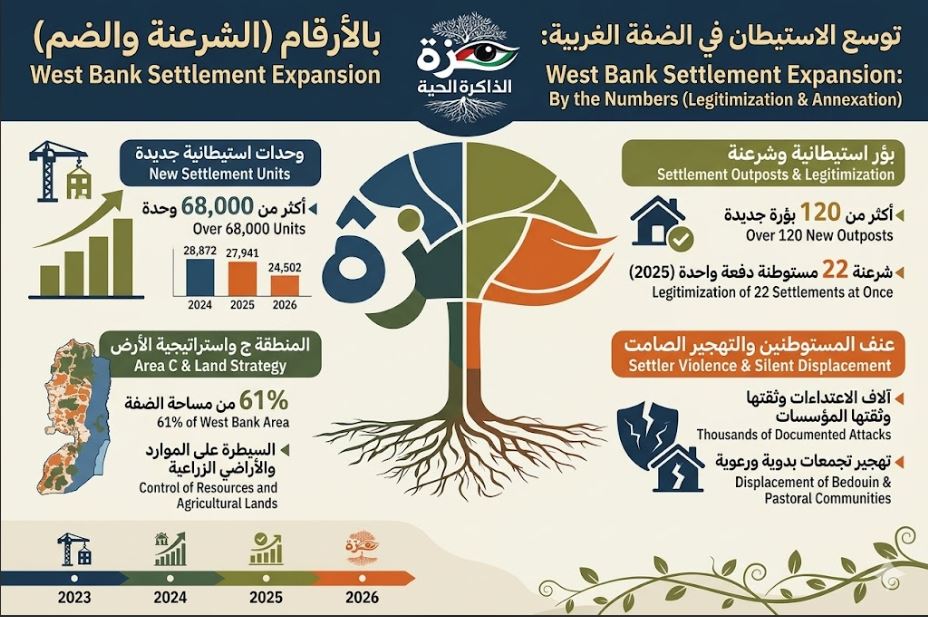
Special Report | Gaza: The Living Memory While the world's attention has largely focused on Israel's war on the Gaza Strip since October 7, 2023, the occupied West Bank has undergone profound and accelerating changes, marked by the largest wave of Israeli settlement expansion since its occupation in 1967. As international attention centered on the devastating humanitarian consequences of the war in Gaza, Israeli authorities moved rapidly to create new realities on the ground in the West Bank through accelerated settlement construction, the legalization of outposts, extensive land confiscation, and the expansion of settler influence. These developments have significantly altered the geographic and demographic landscape of the occupied territory. Nearly three years after the outbreak of the war, the West Bank faces a new reality defined by unprecedented settlement growth, a process many observers describe as the most significant phase of the Israeli settlement project in decades. Settlement Expansion After October 7: Unprecedented Numbers According to data published by Palestinian, Israeli, and international organizations monitoring settlement activity, Israeli authorities advanced plans for more than 68,000 new settlement housing units in the West Bank and occupied East Jerusalem between October 2023 and mid-2026. During the final months of 2023 alone, more than 12,000 housing units were approved, marking one of the highest annual figures recorded in recent years. In 2024, settlement activity intensified further, with approximately 28,872 new housing units approved, including nearly 19,000 units in occupied East Jerusalem alone. The upward trend continued throughout 2025, when Israeli authorities approved approximately 27,941 additional housing units, making it one of the most active years in the history of settlement expansion. By early 2026, thousands of additional housing units were being promoted across various parts of the West Bank, reflecting a sustained commitment to settlement growth. Legalizing Outposts: A Strategic Shift One of the most significant developments since October 7 has been the transition from expanding existing settlements to formally establishing and legalizing new ones. During this period, more than 120 settlement outposts were established or legalized throughout the West Bank. In 2025 alone, the Israeli government approved the legalization of 22 settlements in a single decision, a move widely described as the most extensive settlement authorization since the Oslo Accords of 1993. In 2026, settlement-monitoring organizations reported additional government plans aimed at creating dozens of new settlements, further strengthening Israeli control over Area C and connecting settlement blocs through new infrastructure. Area C: The Primary Target Most settlement projects have been concentrated in Area C, which constitutes approximately 61 percent of the West Bank. This area represents the strategic territorial reserve of a future Palestinian state and contains most of the region's agricultural land, natural resources, and groundwater reserves. Over the past three years, Area C has witnessed extensive settlement expansion, including the construction of bypass roads, the establishment of agricultural and pastoral settler farms, and the seizure of large areas of Palestinian-owned land. Human rights organizations estimate that settlements and regional settlement councils now exercise direct or indirect influence over vast portions of the West Bank. Jerusalem: The Centerpiece of Settlement Policy Occupied East Jerusalem has remained at the heart of Israeli settlement plans. The Israeli government has advanced major projects aimed at strengthening the settlement ring surrounding the city, expanding existing settlements, and creating new settlement neighborhoods. Experts argue that these projects are intended to prevent territorial continuity between the northern and southern West Bank, isolate Jerusalem from its Palestinian surroundings, and secure a permanent Israeli demographic majority within the city. Settler Violence as a Parallel Tool of Expansion Settlement growth has not been limited to construction activity. It has been accompanied by a sharp rise in violence carried out by Israeli settlers against Palestinian communities. Since October 2023, human rights organizations have documented thousands of attacks targeting Palestinian villages and communities. These incidents have included the burning of homes and vehicles, the uprooting of olive trees, assaults on farmers and shepherds, road blockages, and restrictions preventing Palestinians from accessing their agricultural lands. As a result, numerous Bedouin and rural communities, particularly in the Jordan Valley, Masafer Yatta, and areas surrounding Ramallah and Nablus, have been forced to leave their homes. The Silent Displacement of Palestinians Human rights experts regard forced displacement as one of the most serious consequences of settlement expansion during this period. Under the combined pressure of settler violence, land confiscation, military restrictions, and economic hardship, many Palestinian families have been compelled to abandon areas where they have lived for generations. United Nations reports indicate that tens of thousands of Palestinians have been directly affected by settlement-related policies and violence since the outbreak of the Gaza war. The De Facto Annexation of the West Bank A growing number of analysts and researchers argue that developments in the West Bank since October 7 represent more than conventional settlement expansion. Instead, they view them as part of a gradual process of de facto annexation. This process is reflected in: * The establishment and legalization of new settlements. * The expansion of powers granted to settlement councils. * The construction of permanent roads and infrastructure serving settlers. * The integration of settlements into Israeli governmental systems. * The reduction of Palestinian presence in targeted areas. Observers warn that these measures make the prospect of a geographically contiguous Palestinian state increasingly difficult to achieve. Historical Conclusion The years following October 7, 2023, represent one of the most critical periods in the history of the Palestinian-Israeli conflict. While the Gaza Strip endured a devastating war, the West Bank experienced a parallel transformation characterized by extensive settlement expansion and territorial fragmentation. Through the approval of tens of thousands of settlement units, the establishment and legalization of numerous settlements and outposts, and the escalation of displacement and settler violence, the landscape of the West Bank has changed dramatically. For many researchers and historians, this period will be remembered as a turning point in the history of the Israeli settlement enterprise and as one of the most significant efforts to reshape Palestinian geography since the occupation of 1967..