The Commercial Sector in Gaza: The Collapse of the Market System Under War (2023–2026)
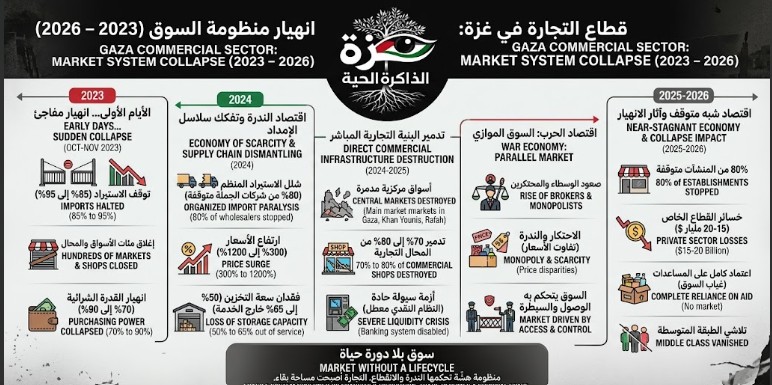
Gaza, the Living Memory – When War Closes the Market's Doors The war that erupted on October 7, 2023, was not merely a military confrontation spanning the geography of the Gaza Strip; rather, it constituted a defining moment that reshaped the economy from its roots—particularly the commercial sector, which serves as the backbone of daily life. In the early days, indicators of collapse began to surface rapidly with the closure of crossings, the halting of imports, and a decline in the flow of essential commodities, alongside widespread disruption in local markets. Over time, discussions shifted from an economic recession to a gradual dismantling of the entire market system. Traditional rules of trade vanished, and the economy transformed into an exceptional state managed by scarcity and necessity. First: The Early Days… A Sudden Market Collapse (October – November 2023) In the opening weeks of the war, Gaza's commercial sector suffered a complex shock that struck all its components simultaneously. Near-Total Cessation of Imports: With crossings effectively closed or minimized to the bare lowest threshold, the entry of essential commercial goods ground to a near-total halt. Foodstuffs, fuel, construction materials, and medical supplies were entering in limited quantities that failed to cover the bare minimum of daily needs. Commercial import activity dropped by an estimated 85% to 95%. Markets Under Shock: Hundreds of popular markets closed their doors, and thousands of small and medium-sized retail shops ceased operations due to destruction, displacement, or supply chain disruptions. Nevertheless, features of a new makeshift market emerged, relying on remaining inventories or sporadically delivered items. Collapse of Internal Demand: Thousands of families lost their sources of income within a short period, and purchasing power plummeted sharply, with drops estimated between 70% and 90%. Following this collapse, the market transformed into a space focused strictly on survival essentials. Second: 2024… The Economy of Scarcity and the Dismantling of Supply Chains As the war entered its second year, the commercial economy transitioned from a state of shock to a continuous, structural collapse. Paralysis of Organized Importation: Organized commercial importing virtually stopped, leaving the market reliant on limited humanitarian aid, old inventories, and small quantities entering irregularly. This situation led to the breakdown of the role of wholesale and distribution companies, which had previously formed the backbone of the market. Estimates indicate that more than 80% of distribution and wholesale companies ceased operations completely or partially. Unprecedented Surge in Prices: Essential goods experienced sharp and recurring price hikes, reaching between 300% and 1200% at certain intervals compared to pre-war levels. Furthermore, some commodities vanished entirely during specific periods, exacerbating the severity of the scarcity. Collapse of Warehousing and Supply Chains: Warehouses faced destruction or disruption, alongside a total loss of storage capacity due to electricity and fuel blackouts. Field estimates indicate that between 50% and 65% of storage capacities rendered out of service. Third: Destruction of the Commercial Infrastructure (2024–2025) With the continuation of military operations, the collapse was no longer just economic but transformed into the direct destruction of commercial infrastructure. Central Markets: Major markets in Gaza, Khan Younis, and Rafah sustained extensive damage or complete destruction, resulting in the loss of primary distribution hubs. Retail Shops: In many areas, between 70% and 80% of commercial shops were destroyed or shut down. Entire commercial neighborhoods that once served as main centers of economic activity completely vanished. The Monetary System: The market faced a severe liquidity crisis due to the significant halt or disruption of banking operations, leading to near-total reliance on limited cash or, in some instances, bartering goods. Fourth: War Economy… The Parallel Market With the collapse of the formal market, an alternative economy forced itself onto reality. The Rise of Middlemen: Brokers and middlemen gained control over the movement and distribution of goods, resulting in major price disparities from one area to another. Monopoly and Scarcity: Certain essential commodities were hoarded and resold at exorbitant prices amid the absence of effective regulatory oversight, turning some materials into tools of influence rather than consumer goods. Market Transformation: The market was no longer subject to the logic of supply and demand alone, but rather to the logic of access, control, and the capability to transport and store. Fifth: Economic Losses of the Commercial Sector Despite the difficulty of accessing precise figures due to the ongoing war, estimates indicate the following: Private sector losses in Gaza are estimated at between $15 billion and $20 billion up to the year 2025. Trade and services account for approximately 40% of total direct economic losses. Losses during the initial months of the war ranged between $1.2 billion and $1.8 billion. Data also indicates the destruction of a major portion of commercial capital, whether through the loss of inventory or the complete cessation of activity. Sixth: Impact of the Collapse on Society Families: Thousands of families lost their ability to secure food regularly and shifted to near-total dependency on humanitarian aid, with consumption dropping to the bare minimum. Traders: The sector witnessed widespread bankruptcy among small-scale merchants, with the complete loss of inventory and capital, and a near-total halt in commercial activity. The General Economy: The internal economic cycle stopped, the natural circulation of money ceased, and the economy shifted from being productive and commercial to an relief-based economy dependent on aid. Seventh: 2025–2026… A Near-Stagnant Economy With the war continuing, the commercial sector entered a state of severe contraction: More than 80% of commercial establishments are completely or partially non-operational. A major decline in the middle commercial class. Near-total reliance on humanitarian aid. Absence of an organized market system. Conclusion: A Market Without a Lifecycle Gaza's commercial sector is no longer merely a damaged sector; it has become a near-collapsed economic structure. The natural relationship between production, import, distribution, and consumption no longer exists, replaced instead by a fragile system governed by scarcity and disruption. Under this reality, trade has transformed from an economic activity into a space for daily survival, while the market remains a witness to one of the deepest economic transformations imposed by the war on Gaza since 2023..