Gaza’s Wounded Abroad: The Medical Evacuation Journey Between Closed Crossings and Long Waiting Lists (October 2023 – June 2026)
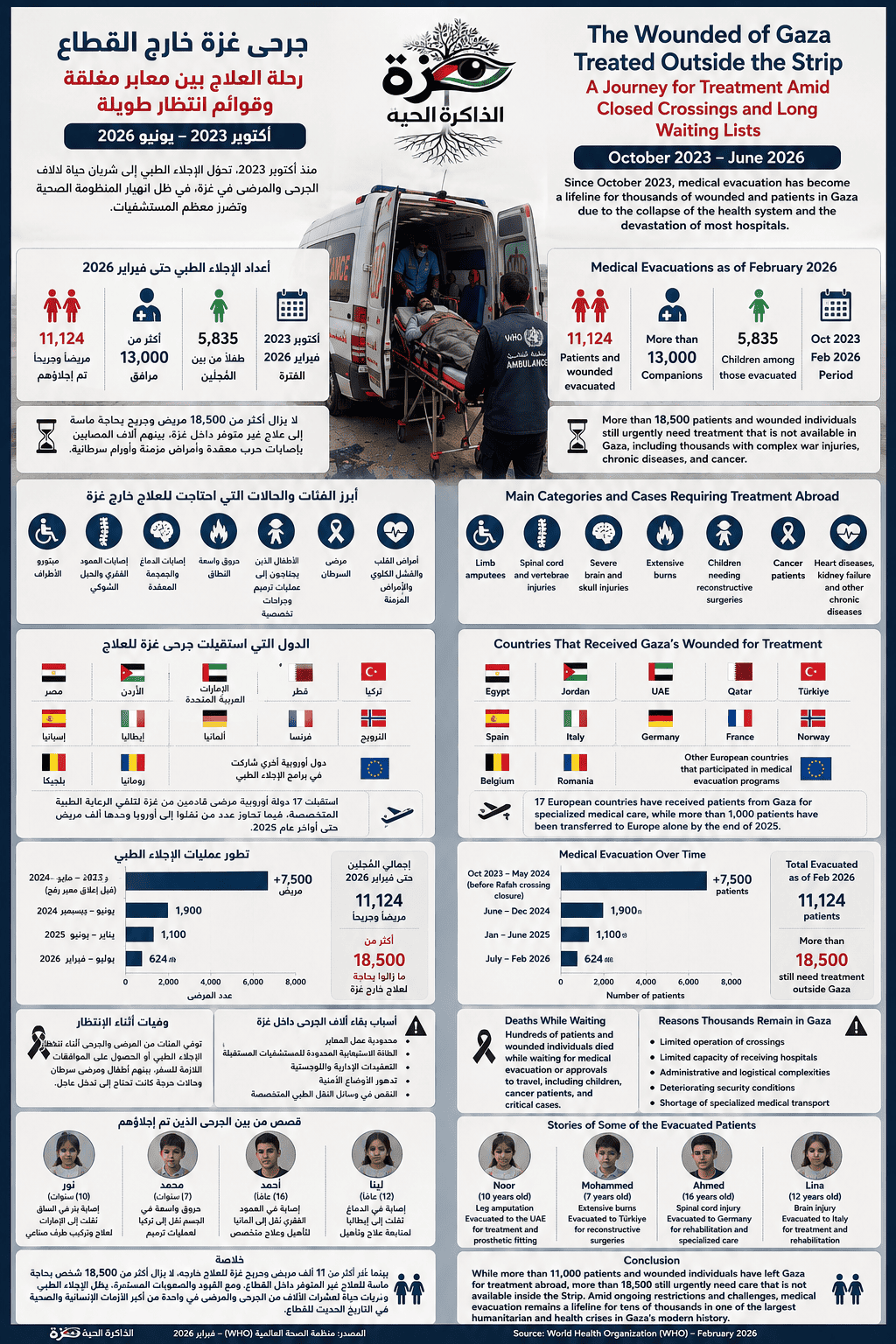
Gaza: The Living Memory— Since the outbreak of the war on the Gaza Strip on October 7, 2023, the medical evacuation of the wounded and sick has transformed into one of the most pressing and complex humanitarian issues. With the widespread collapse of the healthcare system and damage sustained by most hospitals, treating severely injured individuals inside the Strip was no longer viable, making external medical evacuation the sole option to save many lives. However, the path to receiving treatment outside Gaza has been fraught with difficulties. Between closed border crossings, logistical constraints, and a shortage of available beds in receiving international hospitals, tens of thousands of patients found themselves stranded on long waiting lists as their health conditions deteriorated day after day. According to data from the World Health Organization (WHO) up to February 2026, at least 11,124 patients and wounded individuals have been evacuated from the Gaza Strip since the start of the war, accompanied by more than 13,000 caregivers. Among the patients who managed to leave the Strip were approximately 5,835 children. The data shows that the vast majority of evacuations took place during the initial months of the war, prior to the closure of the Rafah crossing in May 2024, during which more than 7,500 patients left the Strip. Following the closure, evacuation rates plummeted drastically, shifting from hundreds of cases per week to extremely limited numbers. According to the WHO, more than 18,500 patients and wounded individuals remain in desperate need of medical treatment that is unavailable inside Gaza. This includes thousands of individuals suffering from complex war injuries, chronic diseases, and cancerous tumors. --- ### Who Needed Treatment Outside Gaza? The medical evacuation waiting lists encompass diverse categories of casualties, most notably: * Amputees requiring reconstructive surgeries and advanced prosthetic limbs. * Patients with severe spinal cord and vertebral injuries. * Complex traumatic brain and cranial injury cases. * Individuals with extensive, large-scale burn injuries. * Children requiring specialized surgical and reconstructive interventions. * Cancer patients whose treatment regimens were entirely halted. * Patients suffering from heart disease, kidney failure, and other chronic illnesses. WHO estimates indicate that thousands of the wounded suffer from "life-altering" injuries—traumas that will stay with them for years and demand specialized treatment and rehabilitation currently unavailable inside the Gaza Strip. --- ### Where Were the Wounded Transferred? Several countries received patients arriving from Gaza, most notably: * Egypt * Jordan * The United Arab Emirates * Qatar * Turkey * Spain * Italy * Germany * France * Norway * Belgium * Romania * Other European nations participating in medical evacuation programs. According to the WHO, 17 European countries have received patients from Gaza to provide specialized medical care, with the number of individuals transferred to Europe alone surpassing 1,000 patients by late 2025. --- ### Gaza's Children at the Top of Evacuation Lists Children constituted the largest percentage of many medical evacuation operations, given the critical nature of their injuries and their acute need for complex surgical interventions. WHO data indicates that thousands of children were placed on waiting lists for treatment abroad, while substantial numbers were successfully evacuated to specialized hospitals across Europe and the Arab world. --- ### Fatalities While Waiting One of the most tragic dimensions of this issue involves the patients who were unable to leave the Strip in time. International reports highlight the deaths of hundreds of patients and wounded individuals while waiting for medical evacuation or awaiting the necessary travel clearances, including children, cancer patients, and critical cases that required immediate medical intervention. --- ### Why Did Thousands of Wounded Remain Inside Gaza? Despite ongoing evacuation efforts, the number of individuals who managed to leave the Strip represents only a fraction of the actual needs. The primary reasons for this shortfall include: * The restricted and limited operation of border crossings. * The constrained receiving capacity of host hospitals. * Pervasive administrative and logistical complexities. * Deteriorating security conditions on the ground. * A severe shortage of specialized medical transportation vehicles. --- International organizations have documented cases of children who lost limbs or suffered severe burns and deformities being transferred for treatment abroad only after months of waiting. Evacuation operations also included patients with complex brain injuries, paralysis resulting from spinal cord trauma, and individuals requiring dozens of successive reconstructive surgeries. More than two and a half years since the outbreak of the war, the medical evacuation file remains wide open. While over 11,000 sick and wounded individuals left the Strip for external medical care, more than 18,500 people are still in need of specialized treatment unavailable within Gaza. Medical estimates suggest that clearing this backlog of cases could take years, even if evacuation operations are significantly scaled up. Consequently, receiving treatment outside Gaza is no longer merely a medical procedure; it has become a vital lifeline for tens of thousands of wounded and sick individuals facing one of the largest healthcare and medical referral crises in the modern history of the Strip..